Editorial note: This guide reflects Internal Revenue Code section 4475 and IRS guidance available as of July 27, 2026. The April 2026 Treasury and IRS regulations discussed below are proposed, not final.
The short answer
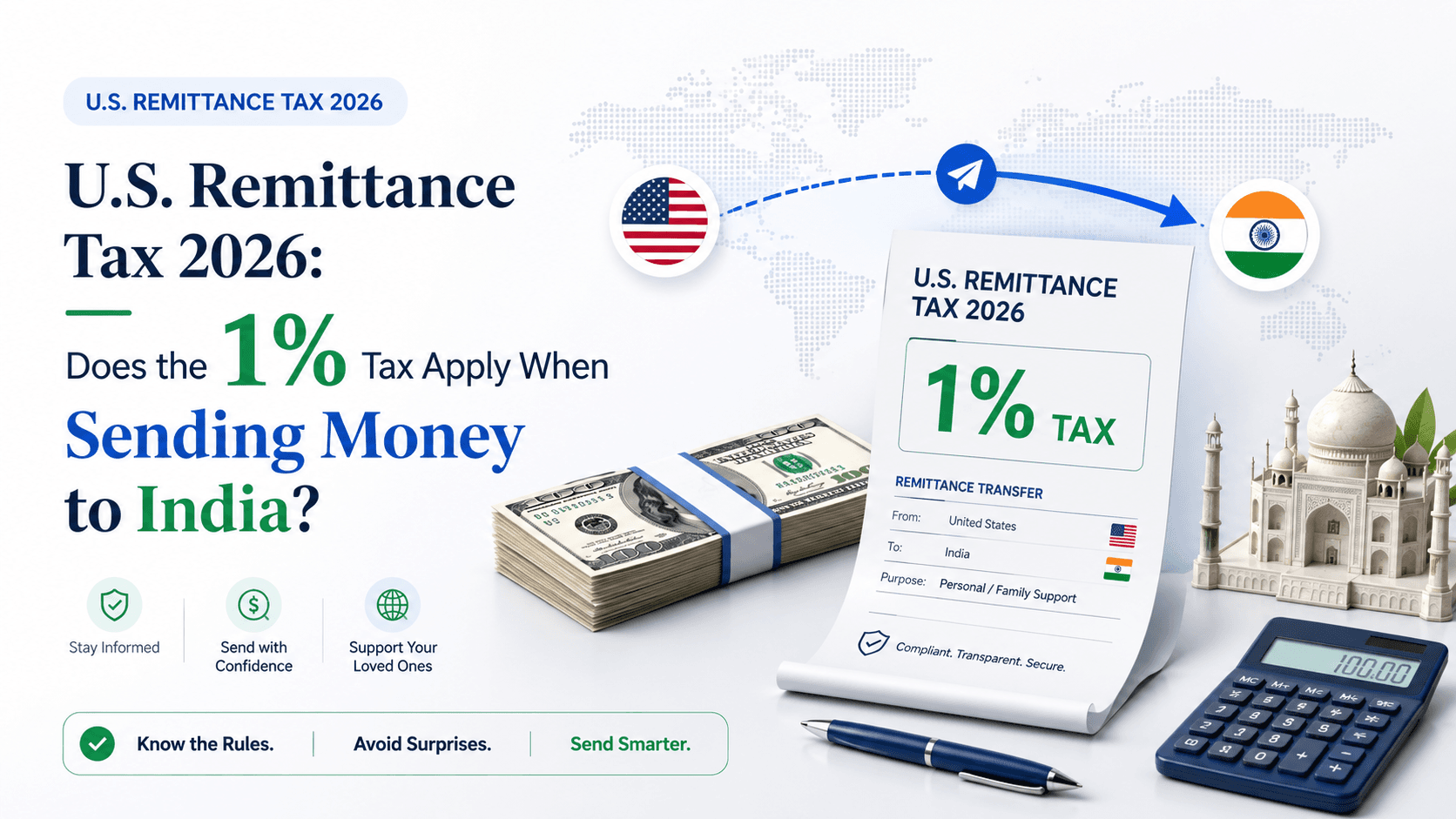
The 1% U.S. remittance transfer tax does not apply to every international money transfer. Beginning January 1, 2026, it applies to qualifying remittance transfers funded with physical cash, a money order, a cashier’s check, or another similar physical instrument identified by Treasury. The IRS’s proposed regulations would also include traveler’s checks.
An ordinary digital transfer funded by ACH, a qualifying withdrawal from a bank or other covered financial account, or a debit or credit card generally does not trigger the tax under the statute and proposed rules. The key question is usually how the transfer is funded—not whether it was started online or whether the recipient is in India.
What is the U.S. remittance transfer tax?
Internal Revenue Code section 4475 imposes a federal excise tax equal to 1% of the amount of certain remittance transfers made after December 31, 2025. The sender is liable for the tax. The remittance transfer provider generally must collect it from the sender and remit it to the IRS. If the provider does not collect it, the statute can make the provider secondarily liable.
The tax is narrower than a general tax on money leaving the United States. The enacted law limits it to remittance transfers for which the sender provides cash, a money order, a cashier’s check, or another similar physical instrument as determined by Treasury. It also excludes qualifying transfers funded by a withdrawal from certain regulated financial accounts or by a U.S.-issued debit or credit card.
The statutory term “remittance transfer” draws on federal consumer-finance law. Not every international payment is necessarily a covered remittance transfer, and payment purpose, parties, provider status, and transaction structure can matter. This guide addresses the common consumer scenario of sending funds from the United States to a designated recipient abroad.
Treasury and the IRS issued proposed regulations in April 2026 to define the tax base, identify traveler’s checks as another taxable instrument, explain other payment methods, and provide examples. Those details are proposed regulatory interpretations and should be described separately from the enacted statute until final rules are published.
Which payment methods trigger the 1% tax?
The table summarizes the enacted statute and the IRS’s proposed regulations. “Generally” matters: the legal treatment can depend on the actual transaction and on how the provider or its agent processes the payment.
| Payment method | Current general treatment | Important qualification |
|---|---|---|
| Physical cash | Generally taxable under the statute | The tax applies when cash is provided to fund a qualifying remittance transfer. |
| Money order | Generally taxable under the statute | The source of funds used to buy the money order generally does not change its treatment. |
| Cashier’s check | Generally taxable under the statute | The instrument is expressly listed in section 4475. |
| Traveler’s check | Included under the IRS’s proposed regulations | Traveler’s checks are not named in the statute; the proposed rules would treat them as similar physical instruments. |
| ACH transfer | Generally not included under the proposed regulations | The IRS proposal does not classify ACH as a similar physical instrument; the transaction must still be evaluated as actually processed. |
| Qualifying bank-account withdrawal | Generally excluded by the statute | The account must fall within the statutory description of covered financial institutions and requirements. |
| Debit card | Generally not taxable | U.S.-issued cards are excluded by the statute; the proposed rules would treat card-funded transfers as nontaxable regardless of issuing country. |
| Credit card | Generally not taxable | U.S.-issued cards are excluded by the statute; other card fees or cash-advance treatment are separate questions. |
| Personal or business check | Generally not included under the proposed regulations | If the provider or its agent cashes a check payable to the sender and uses the cash for the transfer, the proposal would treat it as cash funded. |
| General-use prepaid card | Generally not included under the proposed regulations | An anti-avoidance rule could recharacterize a cash purchase immediately followed by a transfer when tax avoidance is a principal purpose. |
A personal or business check delivered directly as payment is therefore different from a check-cashing transaction. Under the proposal, when a provider or its agent cashes a check payable to the sender and then uses some or all of the resulting cash for the remittance, the transfer is treated as cash funded even if the sender never physically handles the cash.
The proposed anti-avoidance rule also matters. Changing the form of cash moments before a transfer does not necessarily change the substance of the transaction. Readers should rely on the provider’s transaction disclosure and the actual funding flow rather than trying to infer treatment from a payment-method label alone.
How much does the remittance tax cost?
For a taxable transfer, 1% equals one dollar for every $100 in the tax base. These examples assume the transfer is taxable:
- $500 taxable transfer
- $5 tax
- $1,000 taxable transfer
- $10 tax
- $5,000 taxable transfer
- $50 tax
- $10,000 taxable transfer
- $100 tax
Under the IRS’s proposed regulations, the tax base is generally the total amount that will be transferred to the designated recipient. Provider service fees, state taxes, the remittance tax itself, and charges for other goods or services are excluded when they are not transferred to the recipient. A promotional amount that is actually added to what the recipient receives would be included under the proposal.
For example, if a taxable transaction sends $1,000 to the recipient and separately charges a $10 provider fee, the proposed approach generally calculates the federal remittance tax from the transferred amount rather than $1,010. The final provider disclosure should show the transaction-specific amounts.
Does the tax apply when sending money online?
“Online” is not the deciding legal category. The funding instrument and transaction structure matter. Starting a transfer on a website or app does not by itself make the transfer taxable or nontaxable.
A digital remittance funded by ACH, a qualifying withdrawal from a covered account, or a debit or credit card generally differs from a remittance funded by handing physical cash to a retail agent. Conversely, entering transfer details online and then paying cash at an agent location can still produce a cash-funded taxable transfer.
Do not assume that choosing a particular company automatically changes the tax result. A provider may accept several funding methods, and those methods can receive different treatment. Confirm the selected funding method and review the tax, fee, exchange-rate, and recipient-amount disclosures before approving the transaction.
Does the tax apply when sending money from the USA to India?
India as the destination does not, by itself, determine whether the U.S. remittance tax applies. The same statutory funding-method rules generally apply whether the designated recipient is in India or another foreign country.
Example A: A person asks an online provider to send $2,000 to an Indian recipient and funds the transaction through an ordinary qualifying withdrawal from a U.S. bank account. That transfer generally falls within the statutory account-withdrawal exclusion, assuming the account and transaction meet the law’s requirements.
Example B: A person gives $2,000 in physical cash to a retail remittance agent for delivery to an Indian recipient. If the transaction is a qualifying remittance transfer, the cash funding generally makes it subject to the 1% tax, so the tax would ordinarily be $20 if $2,000 is the taxable amount.
These are general illustrations, not determinations about a particular transfer. A provider should disclose applicable taxes and charges before confirmation. For route planning, use RemitLow’s USA-to-India transfer guide and the live USD-to-INR comparison to review transfer options separately from the tax question.
Does the tax apply to Wise, Remitly, Instarem, or another provider?
A provider name alone does not answer the tax question. Treatment depends primarily on whether the transaction legally qualifies as a remittance transfer, the funding method, how the provider or its agent processes the payment, and the final disclosure shown to the customer.
Wise, Remitly, and Instarem can each have transaction-specific eligibility and funding options. Check the funding method and final cost disclosure for the specific transaction rather than assuming every transfer through a provider receives identical treatment.
RemitLow does not determine the tax treatment, collect the tax, or complete transfers. It compares available provider quotes for supported corridors. The selected provider remains responsible for its transaction flow and disclosure. Read how RemitLow orders comparison results and the affiliate disclosure for the distinction between comparison and transfer execution.
Is money received in India taxable?
The U.S. remittance transfer excise tax is separate from whether the payment creates income, gift, reporting, or other tax consequences for the sender or recipient. A transfer can be outside the 1% remittance tax and still raise a different tax or reporting question—or it may raise none.
Separate issues can include U.S. gift-tax or information-reporting rules, Indian income-tax treatment, business-payment rules, property transactions, inheritance-related transfers, and the provider’s fees and exchange-rate costs. The answer can depend on the relationship between sender and recipient, the reason for payment, the amount, residency, documentation, and other facts.
This article does not provide a conclusion about Indian tax treatment. Seek advice from a qualified professional for large gifts, business payments, property transactions, inheritance-related transfers, or repeated high-value transfers. Keep records that explain the payment and retain the provider disclosure and receipt.
How to calculate the true cost of sending money to India
The remittance transfer tax, when applicable, is only one possible part of the total economic cost. A comparison may need to account for the provider fee, exchange-rate markup, payment-method fee, applicable remittance transfer tax, and recipient-side charges where applicable.
Compare the recipient amount rather than focusing only on an advertised fee or exchange rate. A transfer with a low visible fee can still deliver less if its conversion rate is less favorable. A stronger rate can be offset by a fee or funding-method charge.
Review USD-to-INR rate context separately from executable provider quotes. Then compare available transfer results using the same amount, funding method, payout method, and quote time.
Practical checklist before sending
When a proposed rule affects the answer, recognize that final regulations could change the details. The provider’s disclosure is the most relevant record for the transaction you are about to make; this article is a dated educational guide.
- Confirm the funding method that will actually be used.
- Review whether a remittance tax appears in the provider disclosure.
- Compare the recipient amount, not just the advertised fee.
- Check the exchange-rate markup and any payment-method charge.
- Review the delivery estimate and payout method.
- Save the receipt and provider disclosure.
- Seek professional advice for unusual or high-value transfers.
This article is for general informational purposes and is not tax or legal advice. Rules and proposed regulations may change. Review the provider’s transaction disclosure and consult a qualified professional for advice about your circumstances.
Sources
Learn how RemitLow researches and updates content in our editorial policy.