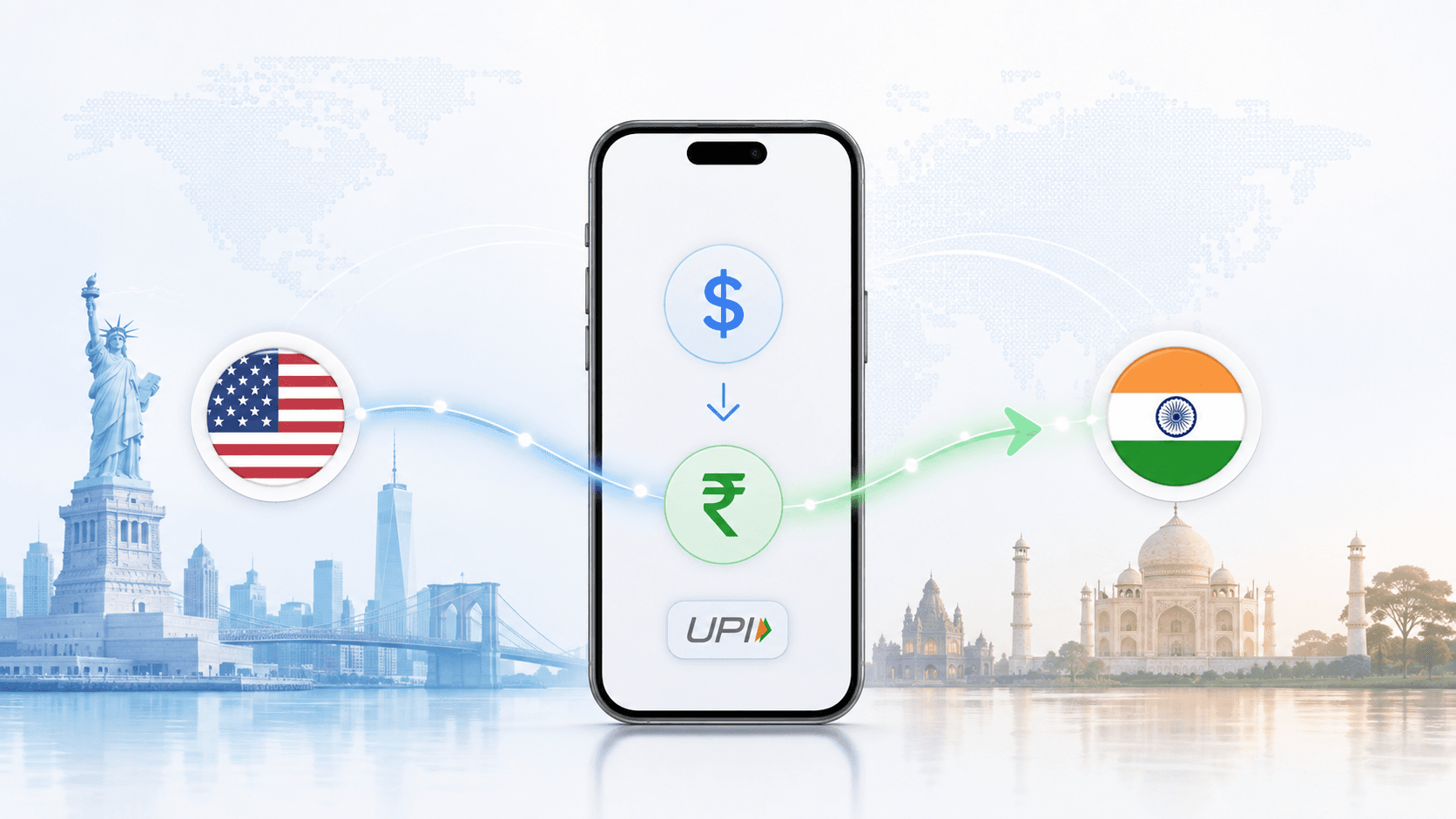
Editorial note: Provider delivery methods, participating institutions, and limits can change. This guide reflects official information reviewed on August 9, 2026; confirm UPI availability and the final transaction terms in the provider’s current transfer flow.
Quick answer
Yes. Some international remittance providers let a sender in the United States fund a transfer in U.S. dollars and deliver the converted Indian rupees to an eligible recipient through UPI. The sender generally is not making an ordinary domestic Indian UPI payment directly from a U.S. bank account.
The remittance provider handles the USD payment, currency conversion, identity and compliance steps, and international transfer process. UPI may be used for the domestic payout leg in India. Support depends on the provider, participating institutions, transfer purpose, recipient account, amount, and transaction eligibility.
What is UPI?
Unified Payments Interface, or UPI, is an instant payment system developed by the National Payments Corporation of India. NPCI describes it as a system built over India’s IMPS infrastructure that can move funds between participating accounts and combine payment functions in UPI-enabled apps.
For many payments, a user can identify the recipient with a UPI ID—also called a Virtual Payment Address or VPA—instead of entering a complete bank account number and IFSC code. The UPI ID maps to an eligible account through the recipient’s participating bank and payment-service provider.
For an international remittance, UPI is relevant to the Indian delivery leg. It does not perform the U.S.-dollar funding, international compliance review, or foreign-exchange conversion. Those parts belong to the remittance provider and its regulated payment chain.
Can you send money from the USA directly to a UPI ID in India?
Not as an ordinary native UPI transfer from a typical U.S. bank account. Domestic UPI payments normally involve a UPI-enabled app and an eligible linked account within the UPI ecosystem. A U.S. sender instead uses an international remittance service that offers UPI as an India delivery method.
NPCI’s foreign inward remittance circular permits the domestic leg of an eligible foreign remittance to be credited through UPI. It requires an audit trail for the remittance chain, credit to a KYC-compliant beneficiary account, and compliance with applicable RBI, FEMA, and other requirements. Participating institutions must enable the functionality.
- USD fundingSender pays an eligible international remittance provider
- Provider processingProvider handles verification, compliance, and USD-to-INR conversion
- Indian payout railAn enabled partner uses the supported domestic delivery mechanism
- UPI recipientEligible INR funds reach the UPI-linked recipient account
Starting a transfer online does not turn a U.S. bank payment into domestic UPI. The provider remains the international transfer service, while UPI can supply a convenient recipient identifier and last-mile credit mechanism in India.
How does a U.S.-to-India UPI remittance work?
The exact screens and information differ by provider. UPI may not appear for every sender, recipient, purpose, amount, or account. If it is unavailable, use another supported payout method rather than entering a UPI ID into a bank-account field.
- Choose an international transfer provider that currently offers UPI delivery for an eligible U.S.-to-India transaction.
- Enter the amount you want to fund in U.S. dollars and select India as the destination.
- Choose UPI as the recipient or delivery method if the provider offers it for that transfer.
- Enter the recipient information requested by the provider, including the UPI ID when required.
- Select an available funding method, such as a bank-account method or card, subject to the provider’s terms.
- Review the exchange rate, provider fee, applicable taxes or charges, final INR recipient amount, and delivery estimate.
- Confirm the recipient and transaction details before authorizing payment.
- Complete any identity, purpose, or source-of-funds checks requested by the provider.
- The provider processes the international remittance and its eligible Indian payout partner handles delivery.
- The recipient checks the linked account and the provider’s transfer status before treating the payment as complete.
What information do you need to send money to a UPI ID?
The provider decides the transaction-level requirements. A U.S. sender commonly needs an account with the provider, legal name, contact and address information, an accepted payment method, and identity verification. Larger or unusual transfers can require information about the transfer purpose or source of funds.
The recipient commonly needs a legal name that matches the eligible account and a correct UPI ID linked to a participating institution. A provider may also request the recipient’s address, phone number, relationship to the sender, transfer purpose, bank details, or additional KYC information.
NPCI’s foreign inward remittance circular says the beneficiary account must be KYC compliant. That does not mean the U.S. sender should collect the recipient’s passwords, OTPs, or UPI PIN. Those credentials are private and should never be shared.
- Sender: legal identity, U.S. address and contact details, accepted funding method, and any requested verification documents.
- Recipient: matching legal name, valid UPI ID or VPA, and an eligible linked account.
- Transaction: destination, purpose, amount, relationship, and other details requested for compliance.
What does a UPI ID look like?
A UPI ID is an address used to identify a user in the UPI system. A conceptual example is name@bank. That example is not a real account and should not be used for a transfer.
The part after the @ symbol is a UPI handle associated with the recipient’s app or payment-service provider; it is not necessarily the recipient bank’s familiar brand name. The recipient should copy the active UPI ID from a trusted banking or UPI app and send it through a channel the sender already trusts.
Do not guess a UPI ID from the recipient’s name, phone number, or bank. Where the provider displays a recipient-name confirmation, check it carefully, but still confirm the identifier independently with the intended recipient.
What is the UPI limit for international remittances?
NPCI’s current UPI FAQ says the transaction limit for the Foreign Inward Remittances category may be up to ₹2 lakh per transaction. This is a UPI category-level ceiling, not a promise that every provider, partner bank, recipient, or transfer can use the full amount.
A lower limit can apply because of the remittance provider’s rules, the sender’s verification level, funding method, transaction history, recipient eligibility, transfer purpose, partner-bank controls, or regulatory review. Wise’s current U.S. UPI page separately states a limit of ₹200,000 for its UPI transfer product, but that provider statement must be reconfirmed before sending.
If the intended recipient amount exceeds the UPI option shown by the provider, compare an eligible bank deposit or another supported payout method. Do not split transfers to bypass verification, compliance, or provider limits.
For amounts such as $10,000, $50,000, or $100,000, use the dedicated guide to large USA-to-India transfers to compare payout limits, documentation, exchange-rate costs, and bank-deposit options.
Which providers let you send money to UPI from the USA?
Current official U.S. documentation explicitly verifies UPI delivery for Wise and Remitly. Availability remains transaction-specific, and neither provider should be assumed to support every sender, recipient, amount, purpose, or institution.
| Provider | What the official documentation shows | Important qualification |
|---|---|---|
| Wise | Its U.S. UPI page says a sender can use the recipient’s name and UPI ID to send INR to India. | Wise says payment-type availability depends on currency or region and currently states a ₹200,000 UPI limit. Confirm the live transfer flow. |
| Remitly | Its U.S.-to-India UPI page instructs senders to choose UPI and enter recipient UPI information. | Remitly says delivery options vary by recipient location and transfer details. Confirm the displayed option, limit, and final disclosure. |
Read RemitLow’s factual profiles for Wise and Remitly. RemitLow also integrates Instarem, but this guide does not list Instarem as a verified UPI-delivery option because current official documentation establishing U.S.-to-India UPI support was not available during this review.
Do not infer current UPI availability from an old provider article, a generic India route, or the fact that a provider supports bank deposits. Open the current transaction flow and confirm that UPI is the selected delivery method.
UPI vs. bank deposit: which should you choose?
Both methods can credit an eligible Indian bank account, but they use different recipient identifiers and may have different provider coverage or limits. Neither is universally faster or cheaper.
| Comparison point | UPI delivery | Bank-account deposit |
|---|---|---|
| Recipient identifier | Usually an eligible UPI ID or VPA plus provider-required details | Usually account number, IFSC, legal name, and provider-required details |
| Availability | Only when the provider and participating institutions enable UPI for the transaction | Often offered for India routes, but still provider and account dependent |
| Convenience | Can reduce the need to type full bank details when the UPI ID is valid | Useful when the recipient has verified bank details or UPI is unavailable |
| Limits | Subject to UPI category, provider, partner, and compliance limits | Subject to provider, bank, funding, and compliance limits |
| Speed | Use the provider’s transaction-specific estimate; UPI does not guarantee end-to-end speed | Use the provider’s transaction-specific estimate; bank processing can vary |
| Larger transfers | The available UPI ceiling may make this unsuitable for some amounts | May support a different limit, subject to provider review and documentation |
Choose the method the recipient can reliably use, then compare actual quotes using the same send amount and funding method. The provider’s INR recipient amount and delivery estimate are more useful than a general claim about either rail.
Does using UPI make an international transfer cheaper?
Not necessarily. UPI is primarily the recipient-delivery mechanism. The total transfer cost can still reflect the provider fee, USD-to-INR exchange-rate spread, funding-method charges, promotional conditions, applicable taxes, and any recipient-side charge disclosed for the transaction.
A “zero fee” label does not prove that a transfer delivers the most rupees. Compare the final INR recipient amount for the same USD amount, then review the fee and exchange rate to understand the result.
Use the USD-to-INR comparator for currently available integrated-provider quotes and the USD-to-INR rate guide to understand the difference between a market reference and an executable transfer quote.
Does the new 1% U.S. remittance tax apply to UPI transfers?
UPI delivery does not by itself determine whether the U.S. remittance transfer tax applies. The relevant U.S. question is primarily how the remittance is funded and how the statutory and regulatory rules apply to that transaction—not which Indian payout rail delivers the rupees.
Read the 2026 U.S. remittance tax guide for the enacted cash and cash-like funding rules and the IRS’s proposed regulatory clarifications. Do not assume a transfer is tax-free merely because the recipient receives it through UPI.
Is it safe to send money using UPI?
Use an authorized remittance provider and its official website or app. Confirm that UPI is offered for the intended transaction, review the provider disclosure, and verify the recipient independently before paying.
The sender should never ask for the recipient’s UPI PIN, password, or one-time verification code. NPCI says a UPI PIN authorizes transactions and should not be shared. The recipient does not need to disclose that PIN merely to receive an eligible inward remittance.
- Ask the recipient to copy the UPI ID from a trusted app instead of typing it from memory.
- Check any recipient-name confirmation and resolve a mismatch before sending.
- Do not respond to an unexpected request to share an OTP, password, screen, or UPI PIN.
- Review the final USD cost, INR recipient amount, delivery method, and recipient details.
- Save the provider disclosure, receipt, and transaction reference.
What if the recipient does not have UPI?
Choose another delivery method that the provider offers for the recipient and transaction. Bank-account deposit is a common alternative. Some providers can offer cash pickup or another payout option for eligible routes, but availability varies.
The broad USA-to-India transfer guide explains bank deposit, cards, cash pickup, recipient details, timing, and safety without assuming every provider supports every method.
How to compare UPI transfer providers
RemitLow orders available comparison results by descending recipient amount after displayed provider fees. Read the comparison methodology and then compare USD-to-INR options close to the time you intend to send.
- Enter the same USD send amount for each quote.
- Compare the final INR recipient amount.
- Check whether the displayed exchange rate or fee is promotional.
- Review the provider fee and any funding-method cost.
- Confirm that the selected delivery method is actually UPI.
- Check the transaction-specific estimated arrival time.
- Review provider, UPI, and verification limits.
- Verify the recipient’s UPI and account eligibility.
- Read the final transaction disclosure before authorizing payment.
Bottom line
UPI can make an international remittance convenient for an eligible recipient because a supported provider may deliver INR using a verified UPI ID. The U.S. sender still uses an international remittance provider; UPI is not the international currency-conversion layer.
Confirm current provider support, recipient eligibility, transfer purpose, and limits. For larger amounts, UPI may not be the available or appropriate payout method. Compare the final INR received, not only a “zero fee” message, and confirm every detail in the provider’s final disclosure.
Sources
- NPCI: UPI product overview
- NPCI: UPI frequently asked questions and transaction limits
- NPCI: Foreign Inward Remittance through UPI circular
- RBI: Money Transfer Service Scheme direct-to-account facility
- RBI: Remittances under MTSS and Rupee Drawing Arrangement
- Wise: send money to a UPI ID from the United States
- Wise: INR recipient verification and UPI VPA
- Remitly: send money to UPI in India from the United States
- Remitly: send money from the United States to India
- Google Pay India: activate foreign inward remittances
- Google Pay: send international money transfers from the U.S.
Learn how RemitLow researches and updates content in our editorial policy.